

From Childhood Treasures to Symbols of Power, Seduction and Trade
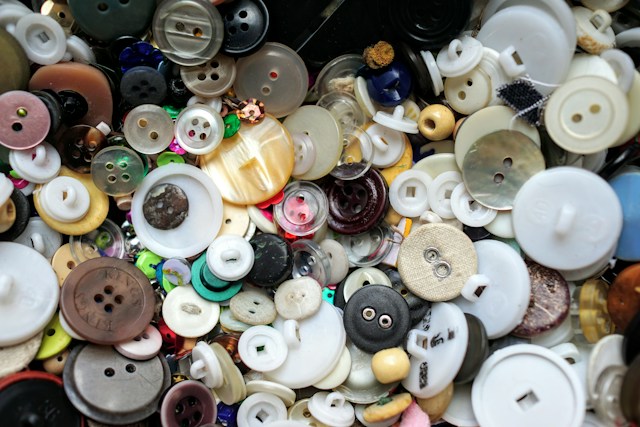
I think we all have fond childhood memories of the button tin.
I could spend hours rummaging for treasures—searching through large buttons, small buttons, all kinds of ancient fasteners, and even the occasional needle, still threaded and long abandoned.
And, if truth be told, our “button tin” was actually a large ceramic pot with a bamboo handle!
It’s strange to think that something as small and ordinary as a button could have such a big impact on the world.
Yet throughout history, buttons have been far more than simple fasteners. They’ve represented wealth, status, fashion, trade and even romance.
So, let’s take a closer look at the surprisingly fascinating history of the button.
More Than Function: The Button as a Symbol
Buttons have a history stretching back thousands of years.
Some of the earliest button-like objects, dating to prehistoric South Asia, were made from shell, sometimes carved and pierced. Often associated with the Indus region, these early examples are thought to have served decorative purposes rather than functioning as the buttons we recognise today.
After all, the familiar button-and-buttonhole combination was still a long way off.
For centuries, buttons could be as much an ornament as a practical object, displaying craftsmanship, personal taste, and, perhaps most importantly, wealth.
Medieval Bling: Dressing to Impress
By the 13th century, buttons were becoming increasingly important in European fashion, both as practical fastenings and decorative features.
And some were certainly designed to be shown off!
Buttons made from precious metals, ivory and other expensive materials may indicate wealth and social standing. Elaborately decorated examples were particularly desirable among those who could afford them.
Ordinary people, meanwhile, generally relied on more affordable materials such as wood, bone and other readily available resources.
A tiny button might seem like an unlikely status symbol today, but in medieval society, what you wore—and how you fastened it—could say a lot about your place in the world.
Sumptuary Laws: When Fashion Possessed Rules
Imagine being told you couldn’t wear a particular item of clothing simply because of your social standing.
In medieval and early modern Europe, this was a reality.
In countries such as England and France, sumptuary laws regulated clothing, including the fabrics, colours, ornaments, and luxury materials different sections of society could wear.
These restrictions could extend to the materials and decorative fastenings used on garments.
Expensive buttons and elaborate trimmings were more than fashionable accessories. They could become visible signs of privilege, strengthening the distinctions between social classes.
In other words, fashion gatekeeping is hardly a modern invention!
Economic Control: Protecting Trade and Industry
Sumptuary laws weren’t always concerned with appearances.
They could also serve economic purposes.
Governments sometimes restricted imported luxury goods to restrain excessive spending on foreign products and encourage national industries.
Textiles, clothing and decorative accessories were all part of an increasingly complex network of trade and manufacture.
Controlling what people could wear was therefore one way of determining how money moved through society.
Morality, Religion and Social Order
These regulations had another side.
Some sumptuary laws were justified on moral or religious grounds, particularly the belief that excessive displays of wealth encouraged vanity, pride and extravagance.
Modesty was considered a virtue, and clothing was expected to reflect a person’s position in society.
Of course, there was often more at stake than simply encouraging modest behaviour.
These restrictions also helped preserve established social orders by making differences in rank and wealth immediately recognisable.
It’s rather extraordinary to think that something as insignificant as a decorative button could become caught up in questions of morality, politics and social control.
The Undressing Game: Buttons in Victorian Fashion
By the Victorian era, buttons had become an established feature of fashionable clothing.
Women’s garments could be wonderfully intricate, with rows of tiny buttons decorating and fastening bodices, jackets, boots and gloves.
Some outfits took considerable time and patience to put on, especially with the period's multiple layers.
And, naturally, getting undressed could be just as involved!
But buttons weren’t simply practical necessities.
In a society which valued public modesty and propriety, fastening or unfastening clothing could also take on a more intimate meaning.
A slowly unbuttoned glove, for example, might suggest something quite different from the everyday business of getting dressed.
In literature and art, gestures involving gloves and clothing could carry romantic or suggestive undertones, expressing the contrast between outward restraint and private feelings.
Of course, not every row of Victorian buttons was intended to be seductive. Many were simply fashionable or functional.
Nevertheless, it’s interesting how an everyday fastening could take on such symbolic meaning.
A button might conceal, reveal, decorate or suggest—and sometimes all four!
Tiny Artefacts, Big Stories
Buttons as Time Capsules
One of the most remarkable things about buttons is their durability.
Long after the garments they once fastened have disappeared, buttons can remain buried in the ground, covered by the sea or scattered across the sites of long-lost settlements.
For archaeologists and historians, these tiny objects may provide useful clues about the people who once owned them.
A single brass military button, for example, might help identify a regiment or narrow down the period in which a battlefield was occupied.
Its design, construction, and markings can provide information that might otherwise be lost.
Of course, a button alone rarely tells the whole story. Its historical background is just as important.
But even the smallest discovery can contribute another piece to the puzzle.
A Connection Across Oceans
Consider a mother-of-pearl button.
Beautiful, isn’t it?
Yet its significance might extend well beyond its appearance.
People traded mother-of-pearl internationally, and buttons made from this material could link an ordinary item of clothing to distant places, specialist craftspeople, and extensive commercial networks.
Depending on the shell’s origin, a button may reveal connections to maritime trade routes that stretched across the world’s oceans.
What seems like a simple decorative fastening can therefore provide evidence of global commerce, changing fashions, and the movement of materials between countries.
The Maker’s Mark: A Hidden Signature
Some buttons carry tiny inscriptions, stamped names or manufacturer’s marks.
These details can be enormously useful to researchers.
A maker’s name might identify a particular workshop, factory, or manufacturing centre, while changes in design and production methods can clue us into a button’s age.
Those discoveries help historians trace industrial growth, the development of manufacturing techniques, and the movement of goods through historical trade networks.
Sometimes, they can even tell the story of an individual garment or its owner.
It’s rather wonderful to think that something so easily overlooked can preserve so much information.
A Little Piece of History
When I think back to that ceramic pot full of buttons from my childhood, I realise I was searching through far more than a collection of spare fastenings.
It held small pieces of family history, even if I didn’t appreciate it then.
And that’s what makes buttons so fascinating.
Over the centuries, they’ve reflected changing fashions, wealth, and social standing; supported industries and international trade; and occasionally played a part in life's more romantic side.
They’ve also quietly accompanied us through the most ordinary moments in everyday living.
Perhaps that’s why so many of us find it difficult to throw away a perfectly good button. We pop it into a tin, jar, or drawer, just in case it comes in useful one day.
So, the next time you come across an old button, take a closer look.
You might just be holding a little piece of history in your hand.
And now I’m curious—did your family have a button tin when you were growing up? Was it an actual tin, or something completely different, like ours?
I’d love to hear your memories.
Comments ()